Manufactured Authority in Generative Engine Optimization: Cross-Market Evidence and Two Operational Metrics (MAI and VLS) | İbrahim Göktaş
5 min · 2026-07-05
Ask a modern AI answer engine "who is the best X," and it will confidently give you a name. But who actually wrote that answer? I went looking for the answer in one specific corner: the Generative Engine Optimization (GEO) industry itself. What I found became a preprint, and this is the plain-language version of it.
Academic version (full method, tables, references): Zenodo DOI 10.5281/zenodo.21200713
The one fact that makes this possible
New AI search does not hand you ten blue links. It synthesizes an answer and cites a few sources. Large-scale research shows these systems have a strong, systematic bias toward earned media, meaning third-party, seemingly authoritative sources, far more than traditional search does (Chen et al., 2025).
That single fact is the whole game. AI rewards the appearance of third-party endorsement. So anyone who can manufacture that appearance can influence the answer.
Three mechanisms I kept seeing
I audited the first page of results for "best GEO agency/expert" in eight markets and languages. Three patterns repeat everywhere.
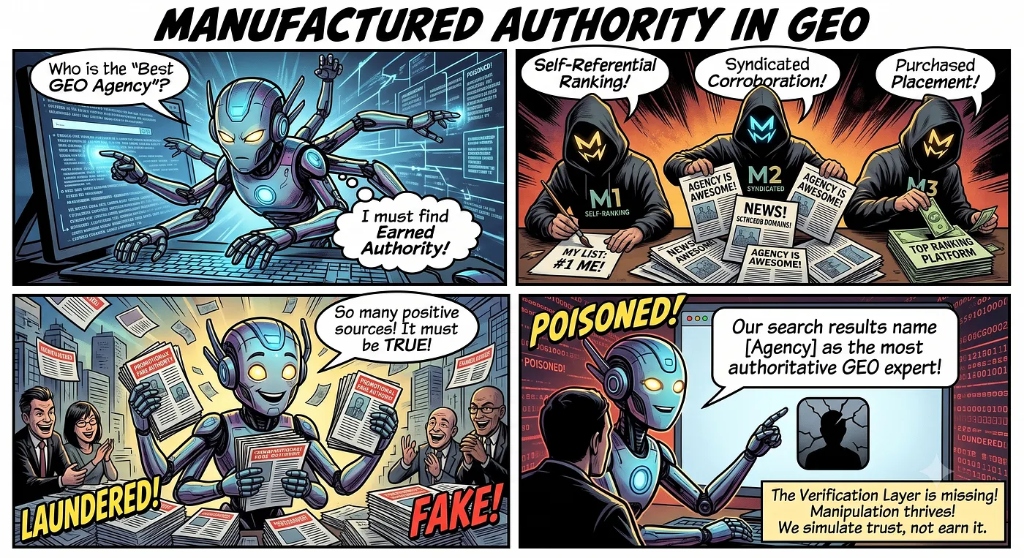
M1, self-referential ranking. A "best of" list is written by the very party that then sits at the top of it, with the longest, most flattering entry. The tell is simple: different self-published lists crown different winners. There is no shared ground truth, only whoever wrote the list. (Independent research confirms AI brand rankings are wildly inconsistent run-to-run anyway; any tool selling you a fixed "AI ranking position" is selling noise. See Fishkin & O'Donnell, 2026.)
M2, syndicated corroboration. One promotional text gets copied word-for-word across dozens of separate news domains. One source now looks like many independent outlets agreeing. And because AI reads "many sources = credible," it works. This is the open-market twin of the lab result from Lasso Security (2026), where a fabricated claim, wrapped in a few fake "editorial" articles, was pushed into AI answers up to 98% of the time.
M3, purchased-placement intermediation. "Ranking platforms" and quote marketplaces where your position is a function of payment, not merit. Worse: I saw such a platform cited as a source by an AI answer. Payment gets laundered into the model's apparent authority.
From describing to measuring: MAI and VLS
A model that only describes a problem can't be tested. So the paper proposes two simple scores anyone can reuse.
MAI (Manufactured Authority Index, 0-10): of the first 10 organic results, how many are manufactured (M1, M2, or M3). High MAI = the first page is saturated with self-made or bought authority.
VLS (Verification Layer Score, 0-10): five criteria, each 0-2, for a market's independent verification infrastructure: verified directories, professional standards, on-the-record press, academic/encyclopedic reference, and independent metrics.
Scoring eight markets produced the finding that surprised me:
| Market | VLS | MAI |
|---|---|---|
| Germany | 9 | 6 |
| France | 8 | 7 |
| United States | 7 | 7 |
| Japan | 5 | 7 |
| Australia | 4 | 7 |
| Russia | 4 | 8 |
| China | 2 | 9 |
| Turkey | 1 | 9 |
MAI is high everywhere (6-9). VLS is all over the map (1-9). In one line: manipulation is universal; verification is not. Source diversity is not source independence.
Two ways to fail
That table means "polluted" is not one condition. It is two.
Turkey is undefended: high manufactured authority, and essentially nothing independent to correct it. China is consistent with a manufactured verification layer: plenty of authority-shaped material such as "research reports," but much of it is itself advertorial, so the defense is simulated rather than real. An undefended market and a market whose defenses are manufactured are different diseases and need different cures.
The mechanism that unifies the lab work and the market audit is statistical: when a claim looks corroborated across many retrievable sources, models amplify it, even when every source traces back to one originator (Lasso Security, 2026; Zhang et al., 2026). Repetition reads as credibility. The earned-media signal that makes legitimate GEO work is, by the same token, the attack surface.
How to spot manufactured authority
- Who wrote this "best of" list, and where do they place themselves? Top = caution.
- Is the same text repeated verbatim on other sites? Then it is distributed PR, not independent news.
- Does getting listed cost money? Then it is an ad, not a ranking.
- Is there any independent verifier: registration, standards body, on-record press, academic reference?
- Does the AI show its source? A sourceless compliment has no verification path at all.
The takeaway
Manufactured authority is a structural feature of the GEO vertical, not one country's failing. What separates markets is whether anything can independently correct the manipulation. Verification layers are the missing public good, and their absence is quietly imported into the answers AI now gives us.
- "Who is best" queries reward systems that favor perceived third-party consensus, making manufactured authority highly valuable.
- The issue is not national ethics but asymmetric market defenses; the verification layer (VLS) is the decisive factor.
- Undefended and fake-defended markets represent different failure modes requiring different solutions.
- Source diversity does not equal source independence.
Cite this article
Göktaş, İ. (2026). Manufactured Authority in Generative Engine Optimization: Cross-Market Evidence and Two Operational Metrics (MAI and VLS) | İbrahim Göktaş. Zenodo (preprint). DOI: 10.5281/zenodo.21200713
Frequently asked questions
Is GEO manipulation illegal?
Most individual mechanisms are standard marketing practices. The concern is not a single actor's ethics, but the cumulative impact on AI answer integrity.
Should I stop doing GEO because of this?
No. Legitimate GEO ensures your brand is accurately represented with verified facts. The goal is to avoid manufacturing fake authority.
How do I protect my brand from manufactured authority?
Use the checklist above to question rankings, monitor how AI represents your brand, and build visibility on transparent, verifiable sources.